How AI Is Changing Knowledge Work: a letter from the present future

Summary: Almost all knowledge work follows a loop: Analyze, Ideate, Decide, Execute. Until now, execution ate 70% of your week. AI is crushing that down to 25%, and when execution stops dominating, everything changes. You go from managing two projects to orchestrating five. The catch? It means letting go of the craft you spent years building and becoming something closer to a conductor of AI agents. Some have already made the jump. Here’s what the world looks like from the other side.
“The future is already here, just not evenly distributed.” That’s how I started my last article, and it’s even more true now. I’m writing from one of the uneven parts.
I keep talking to engineers, product managers and founders who are operating in what I’ve called Sphere 6: you and an AI co-manage a portfolio of work, spawning sub-agents, reviewing output, making judgment calls. More of them every month. And their work looks fundamentally different from what most people around them are doing. These folks are already living in the future that the rest of the world will eventually catch up with.
This will be an upheaval for many, an opportunity for others. But almost no one is prepared for the psychological shift it requires.
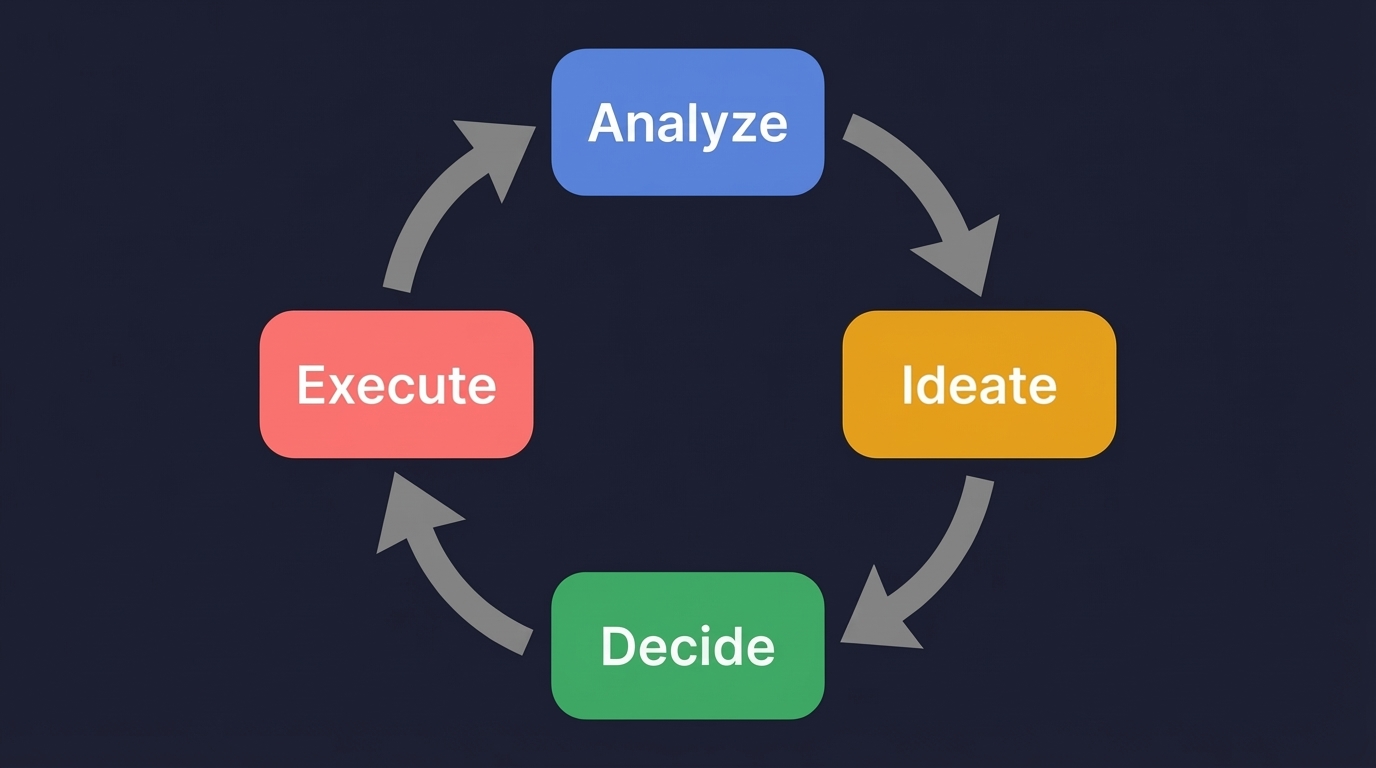
The Loop
In my experience, high performance knowledge work follows a four-stage loop. I was taught a variant of this by Sebastian Thrun when I was on my first Google project. There are lots of other variants, but it doesn’t really change much for the purposes of this analysis.
- Analyze: Understand the problem. Gather data. Read the landscape.
- Ideate: Generate possible approaches. Brainstorm. Explore the solution space.
- Decide: Pick an approach. Commit to a direction.
- Execute: Build the thing. Write the code. Draft the document. Ship.
Click to expand
This loop repeats. You finish one cycle, learn something, and start the next. There are rules of thumb about the ordering: you usually want the stages to be discrete — you don’t want to overlap the decide and execute phases. You don’t want to start analysis of the next cycle before you’re done with the execute phase.
Until now, the ratio between these stages is not even. Not even close.
The Math of a Knowledge Worker’s Week
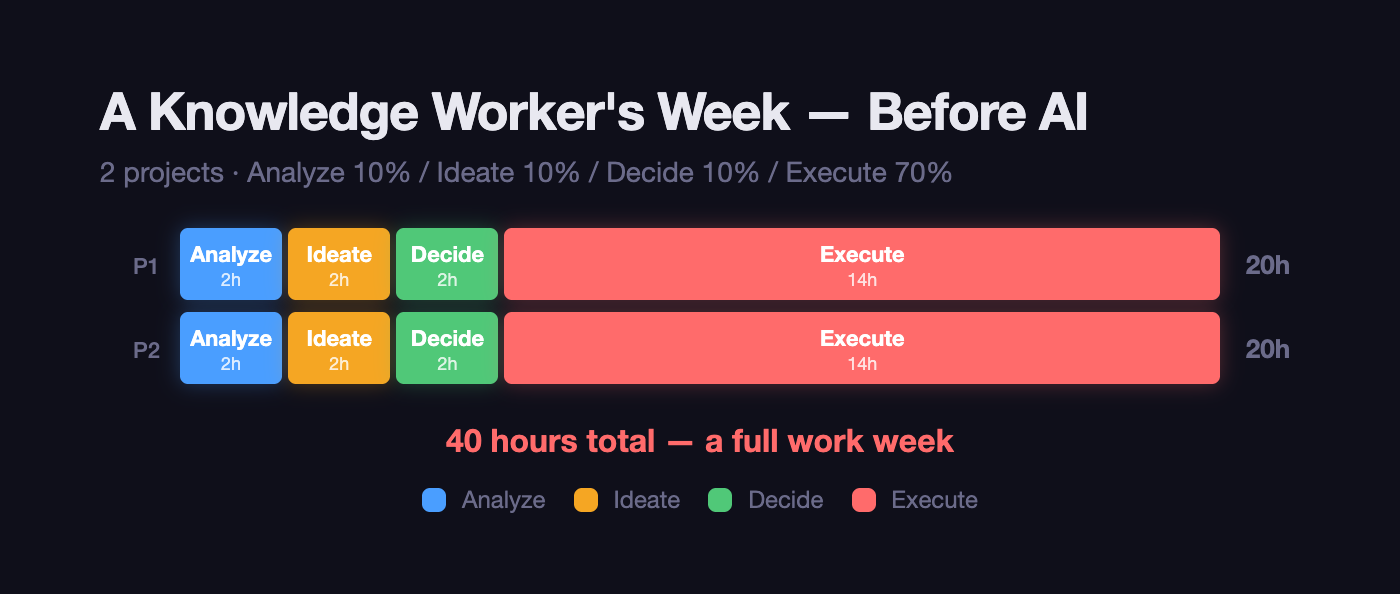
Let me make this concrete. Imagine a pre-AI knowledge worker’s week. They’re juggling two projects (that’s just generally what high performance people do in my experience because half the time you’re waiting on other things or people — we’ll come back to that). For each project, the time breaks down roughly like this:
- Analyze: 2 hours
- Ideate: 2 hours
- Decide: 2 hours
- Execute: 14 hours
Again the details vary, but stick with me here to see the big picture. That’s 20 hours per project. Two projects. 40 hours. A full work week, neatly consumed.
Click to expand
Notice what dominates. The “Execute” phase eats 70% of every project. This is the typing, the building, the drafting, the coding, the formatting. The thinking phases (Analyze, Ideate, Decide) collectively take 6 hours. The execution takes 14.
What AI Does to the Loop
Now AI enters the picture. And the first thing it does is crush the “Execute” phase.
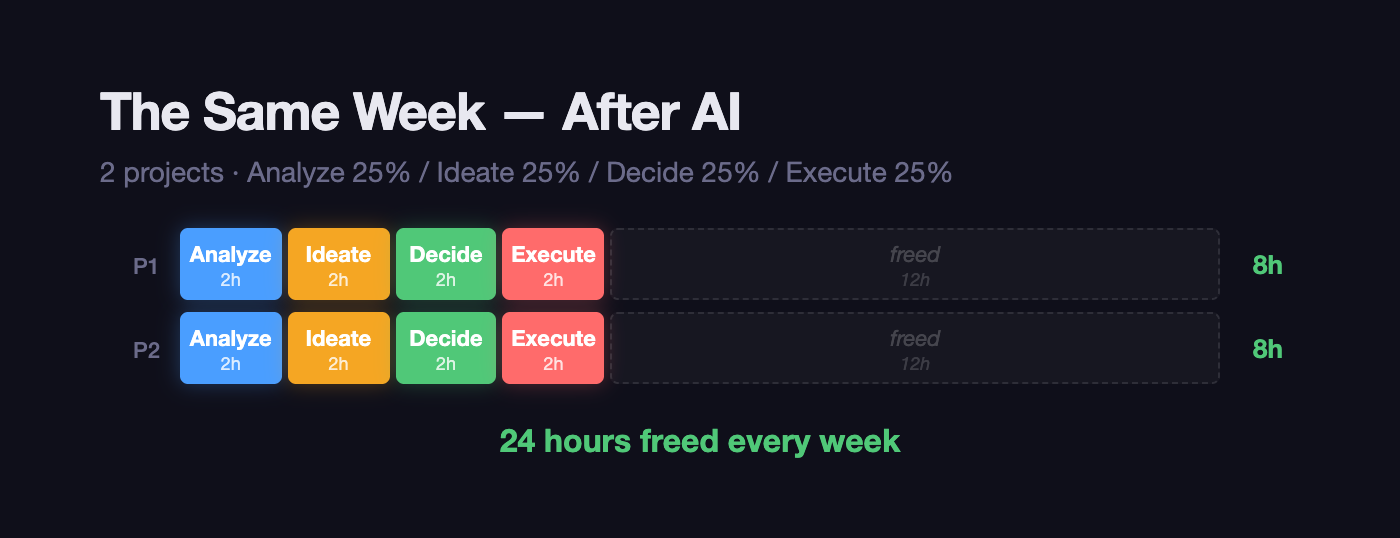
That 14-hour execution block? If you’re using AI in a way that fully exploits agentic capabilities, including using agents to help you manage the work of other agents (Sphere 6), it drops to something like 2 hours of your focused attention. The AI writes the code, drafts the document, generates the tests, formats the output. You review, course-correct, and approve. Not everyone is yet at that level, but they do exist, and they are seeing 7x gains on the “execute” phase. The other stuff: analyzing, ideating and deciding are seeing efficiency gains too, but nowhere near the gains on the “execute” part.
Click to expand
Each project now takes 8 hours instead of 20. Two projects: 16 hours. Your entire week’s work now fits in two days.
That’s a massive change and that’s where the upheaval will come from. If you’re a company in steady state with normal rates of growth, you can now let go of half of your team. If you’re a high growth company and you see your knowledge workers as the engines of your growth, both the quality and quantity of work go up.
That only happens if you have the right type of employees and those employees are ready to embrace this new world. The AI revolution has effectively turned everyone into a manager. Except they manage agents, not people. And that’s a difficult transition for almost anybody, because it requires a different skill set to succeed.
The Catch: Attention vs. Wall Clock
So you can now do the same work 250% faster, right? Not exactly. There’s a subtle but important distinction that most people miss.
There’s focused attention time, and there’s wall clock time.
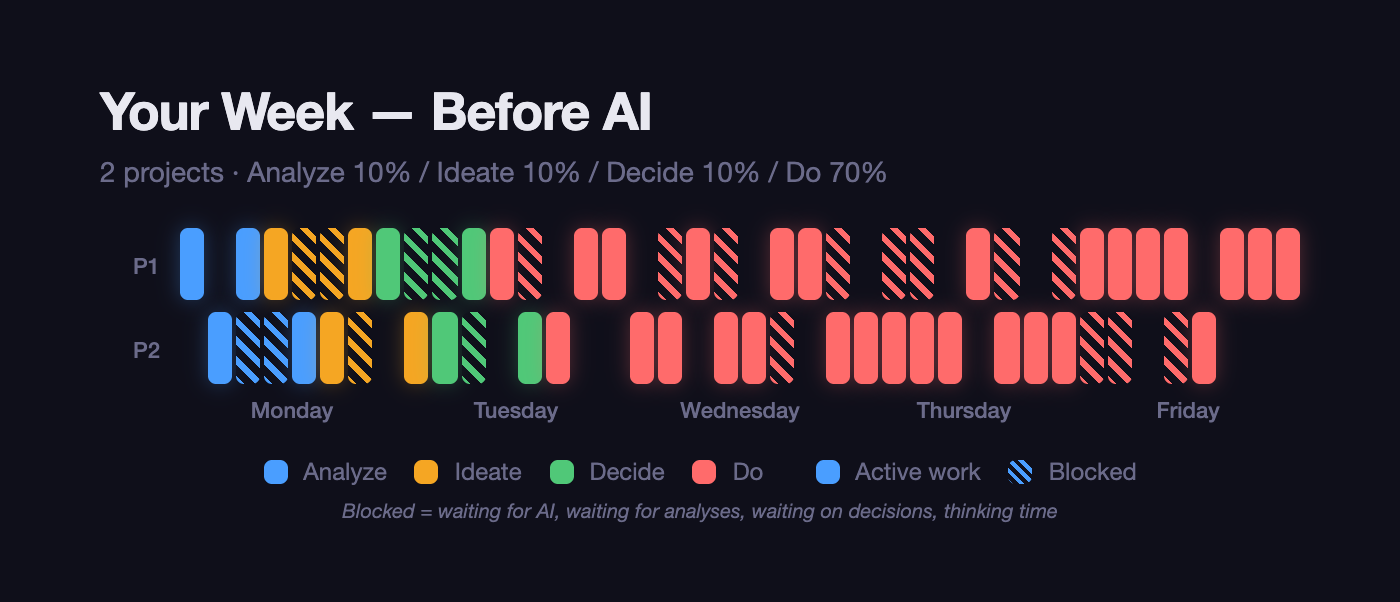
The AI might compress 14 hours of your execution work into 2 hours of your attention. But the AI itself might need 10 hours of wall clock time to do it. Code needs to compile. Tests need to run. Agents need to churn through problems. You’re not sitting there watching the cursor blink for all of it (or at least you shouldn’t be), but the calendar time is real.
The same is true for the thinking phases. You can’t just sit down and say “ideate” and have brilliant ideas appear on demand. Analysis requires reading, absorbing, letting things percolate. Decisions require weighing tradeoffs, sleeping on it, getting a gut check from someone you trust. These phases have a wall-clock floor that no amount of AI can compress.
Here’s what that looks like as a week. Each row is a project. Solid cells are when you’re actively working. Hatched cells are blocked time (waiting for results, thinking, percolating):
Click to expand
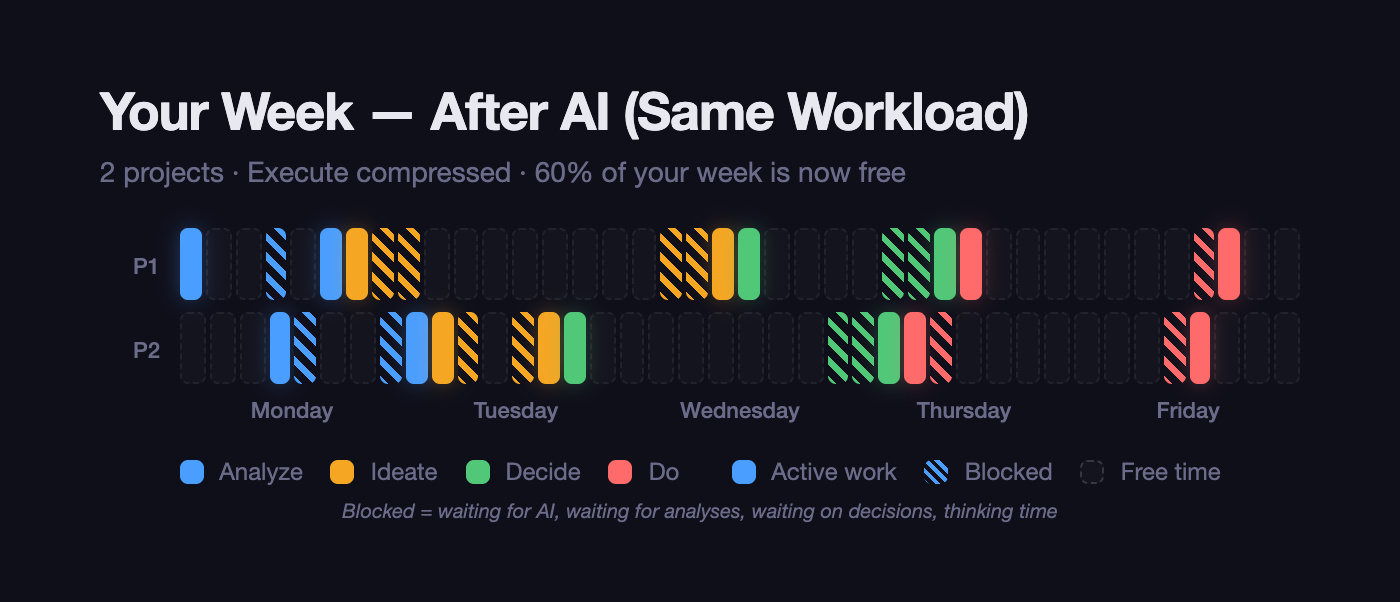
Now here’s the same workload after AI. The Execute phase compresses dramatically, but the thinking phases still take wall-clock time. Most of your week is now free:
Click to expand
The AI shrinks your attention budget dramatically. But it doesn’t shrink the calendar the same way.
The Natural Consequence: Parallelism
And this is where things get interesting.
If each project only requires 8 hours of your focused attention per week instead of 20, the obvious question is: what do you do with the other 24 hours?
The answer, for the people I’m talking to, is: more projects.
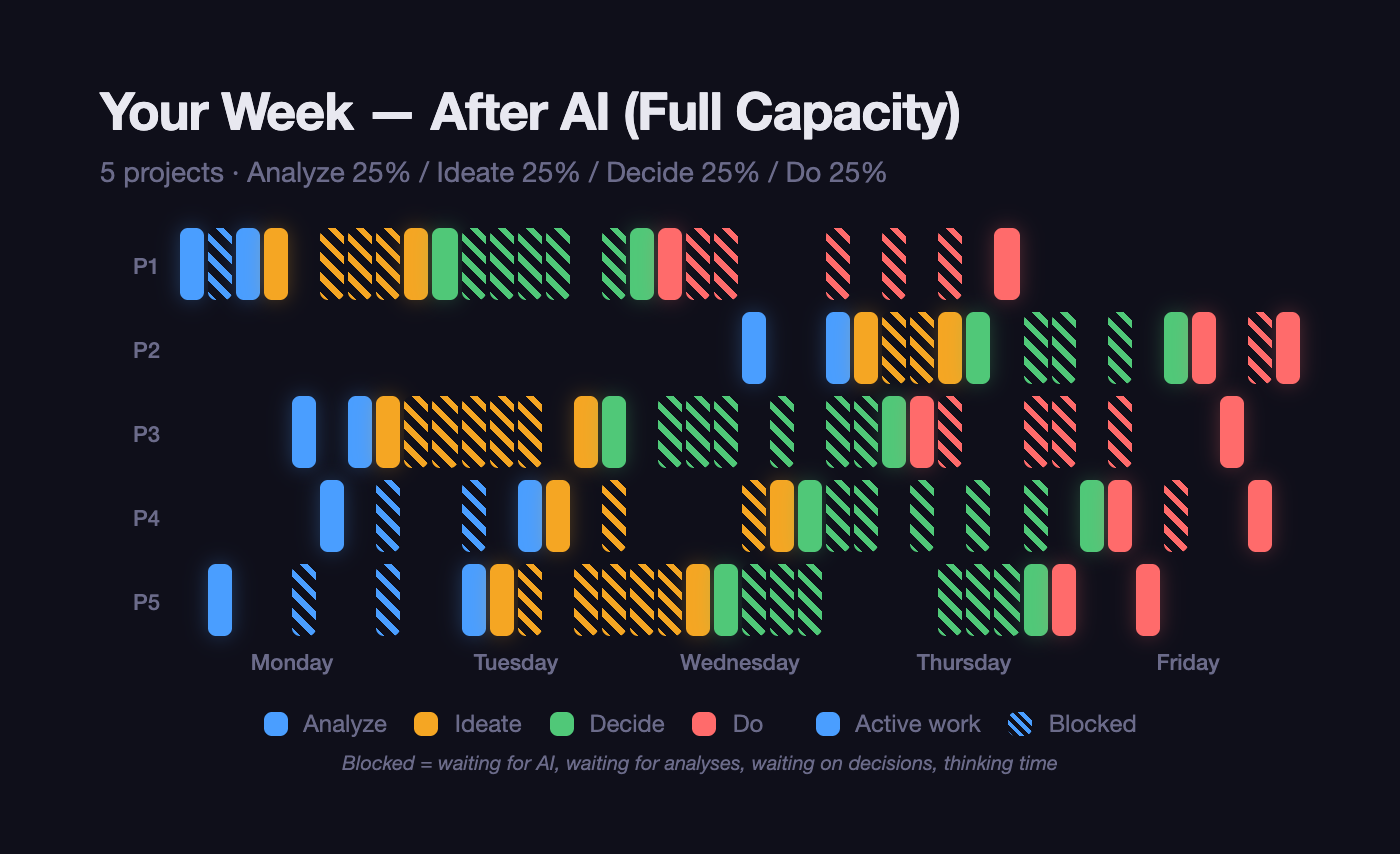
Not busywork. Not make-work to fill the hours. Genuinely parallel streams of meaningful work. If you can manage two projects in 16 hours of attention, you can manage four or five in 32-40 hours. The AI handles the execution in parallel (different agents, different worktrees, different streams), and you rotate between them, providing the human judgment that each one needs: the analysis, the ideation, the decisions.
Click to expand
There is a lot of research that shows that humans are not good at multi-tasking at this level. My rule of thumb used to be never work on more than 3 streams at once. But I also have another aphorism: “The solution to most problems that AI introduces is more AI.” That’s what the people operating at this level are doing. They have something akin to a “chief of staff AI” that helps manage other AIs. The AI doesn’t just do the execution; it summarizes the state of each project when you switch contexts, so you’re not holding five project states in your working memory. You drop in, make the judgment call, and move on. That’s why many agents (such as Claude Code and Codev) are now building in the ability to manage other agents.
This is the shape of work that’s emerging. Not “do the same things faster” but “do more things at the same pace of attention.”
What This Changes
Two things follow from this, and they’re both significant.
First: not everyone will accept this. The compression from 14 hours to 2 is not magic, and it’s not free. It requires trusting AI with execution, and a lot of people will resist that. Viscerally.
When something that used to take you 14 hours now takes 2, the instinct isn’t celebration. It’s suspicion. “There’s no way it’s doing it right.” “You’re cutting corners.” “The craft matters.” I’ve heard all of these.
There’s a version of this debate that’s been happening since the first chainsaw. Axes are precise. Axes are artisanal. Axes give you a feel for the wood. All true. And almost nobody uses an axe to fell a tree commercially. The chainsaw won, not because axes are bad, but because the economics are overwhelming. The people who insisted on axes didn’t preserve the craft. They just stopped being competitive.
The same thing is happening right now with AI and execution work. The people who accept the compression and learn to work in the new ratio will push further: can AI handle some of the analysis? Some of the ideation? Can I automate the routine decisions and reserve my judgment for the hard calls?
The answer is yes, increasingly. And the target keeps moving. Things that required human attention six months ago are now automatable. Things that seem impossible to automate today will be routine by next year. Automatability is not a fixed line. It’s a frontier, and it advances every time a new model drops.
Second: it rewards a very different kind of worker. The old model rewarded deep focus on a single problem. Headphones on, IDE open, eight hours of uninterrupted coding. That was the archetype of the productive knowledge worker.
The new model rewards something closer to a conductor. Someone who can hold five projects in their head, context-switch efficiently between them, make quick judgment calls, and delegate execution to AI agents. The bottleneck shifts from “how fast can you type” to “how many streams of work can you orchestrate.”
This isn’t a minor adjustment. It’s a fundamental change in what “being productive” means. And it will favor different people in the workforce. The quiet heads-down executor who thrives in isolation is no longer the archetype. The person who can juggle, prioritize, and make rapid judgment calls across multiple streams? That’s the new high performer.
It’s a hard thing to come to terms with: the “craft” part of the work, the “doing” you spent years studying and gaining experience in, can now be done by a machine in 1/7th the time. The issue is people don’t think of “coordinate, analyze, ideate, decide” as “real work.” I’ve seen the same struggle when people become first-time managers. I used to have a joke I’d tell managers I was helping to nurture: “When I became a frontline manager, I felt guilty when I was not coding. As I grew and took on more teams I realized I should feel guilty when I was coding.” The real value was always in the coordination, the analysis, the ideation, the decision-making.
The Elephant in the Room
Let’s address it directly. If a team of 10 can now do the same work with 4 people, what happens to the other 6?
The short-sighted answer is: layoffs. And some companies will do exactly that. Cut headcount, pocket the savings, call it efficiency.
The smarter answer is: keep the 10 and translate the freed capacity into growth. If your team can now do 2.5x the work, you don’t shrink the team. You expand the ambition. The projects you couldn’t justify staffing for? The markets you couldn’t afford to enter? The quality bar you couldn’t reach because everyone was buried in execution? Now you can.
The companies that treat AI as a cost-cutting tool will save money in the short term. The companies that treat it as a growth multiplier will eat them alive.
And zoom out even further. If humanity can get its knowledge work done in 40% of the time, that’s not a crisis. That’s the best thing that has happened to us since the industrial revolution. The question is whether we’re wise enough to translate that into better lives for a broad swath of humanity, rather than just making a few billionaires into trillionaires.
The Opportunity
There are enormous opportunities in helping people navigate this transition.
Most knowledge workers have never had to manage five parallel workstreams. The tools aren’t built for it. The workflows aren’t designed for it. The habits aren’t there. Context-switching is genuinely hard for humans, and doing it poorly (which is the default) destroys the very productivity gains that AI creates.
The people who figure out how to help others manage the parallelism, whether through tools, frameworks, training, or new organizational structures, are sitting on something big. This is an unsolved problem right now, even for the people already living in it.
A Dispatch, Not a Prediction
I want to be clear about what this is. I’m not predicting the future. I’m describing what’s already happening for a growing number of people. The future is here. It’s just not evenly distributed.
But the distribution is shifting. Fast. And the gap between “people who have restructured their work around AI” and “people who haven’t” is going to become one of the defining professional divides of the next few years.
I’m writing from one side of that divide. Come on over. The work is different here. You learn to love getting more done, and you realize you aren’t letting go of the craft — you’re just trading the craft of execution for the crafts of analyzing, ideating, and deciding.
Written with AI at Sphere 4 (Partner). I have reviewed every word and am fully responsible for the content.